
Interview Video
Watch the Martha Rice Interview
Guest Information

Testimonial
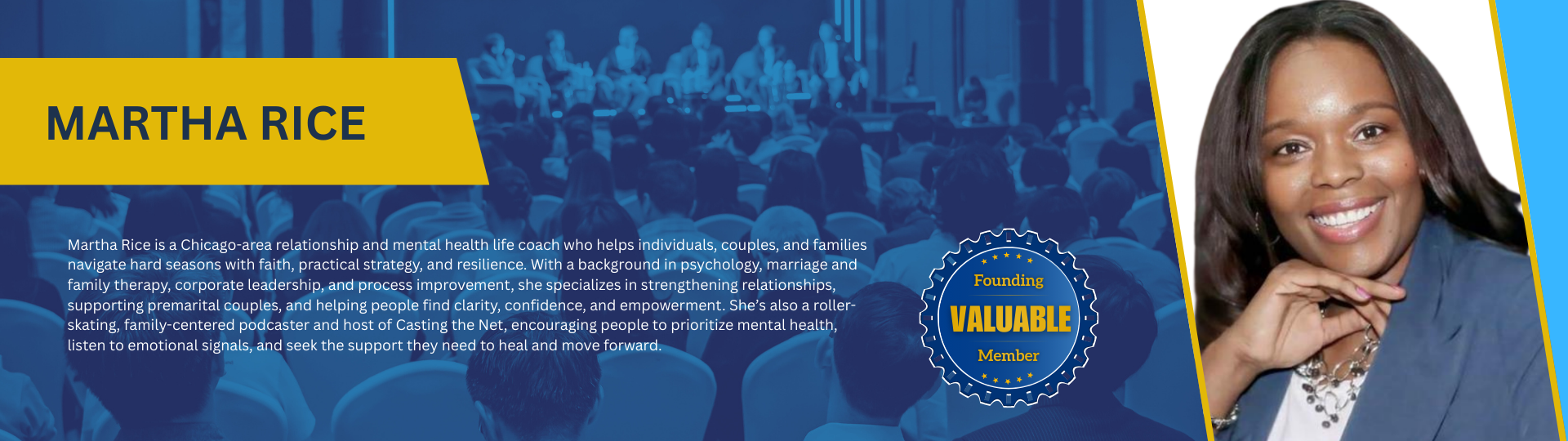
Martha Rice
🔥 In this powerful interview, Coach Martha Rice — relationship & mental health coach, and founder of Casting the Net Podcast 🎙️ — shares her journey of healing after her parents’ divorce at a young age 💔 and how God transformed her pain into purpose 🙌.
💡 Martha’s compassion shines through as she helps her clients break free from limited thinking 🚪➡️🌅, renew their minds 🧠✨, and step boldly into God’s plan for their lives. 🌟 After working with her, clients experience major breakthroughs ⚡, deep healing 💖, and a renewed sense of identity and direction 🎯.
🔥 If you’ve ever felt stuck, wounded, or unsure of your worth, this conversation will give you hope, encouragement, and practical wisdom to step into freedom and live aligned with God’s purpose 🙏
Question & Answer

Martha, your bio mentions “seasons of loss, transition, healing, and breakthrough.” How do those seasons shape your coaching today?
Martha says those real-life chapters became her testimony. They’re the reason she coaches with both compassion and accountability, helping people break free from limiting beliefs, renew their minds, and realign with God’s purpose using practical tools plus biblical wisdom.
You’ve done a lot, from fashion and corporate leadership to therapy training. How did that “diverse” journey lead you into coaching?
Martha explains she always had a heart for mental health, even as a child. Her path included fashion design, corporate leadership, earning a psychology degree, and a master’s in marriage and family therapy, plus Lean Six Sigma process-improvement work. All those skills became transferable, and coaching became the place where everything finally “clicked” into a calling.
What’s your coaching “sweet spot” now?
Relationships. Martha says she especially loves working with families and couples, noticing dynamics even in how people sit and interact. She also does premarital coaching and focuses on relationships in three directions: with yourself, with others, and with God.
What kind of transformation do clients experience after working with you?
Martha describes people often coming in feeling anxious, skeptical, and curious, but leaving with clarity, confidence, and empowerment. She credits that shift to inviting the Holy Spirit into her sessions, relying on God for insight, questions, and direction beyond her training.
You talk openly about “unworthiness.” What’s an example from your own life, and what encouragement would you give someone struggling today?
Martha shares that her parents divorced when she was seven, and in that chaos she internalized the belief it was her fault, which fueled unworthiness and later struggles like emotional eating when stressed. Her encouragement: pay attention to what your body is signaling, don’t override it, and get support (coach, therapist, pastor, whoever helps). She even recommends a “yearly physical” style mental health check-in to identify areas that need care.